Caspase-Mediated Apoptosis in EBC-46 Tumour Cell Death: The Executioner Pathway
How caspase-3 and caspase-9 activation contributes to programmed tumour cell death following tigilanol tiglate exposure, and what cell-line studies have observed downstream.

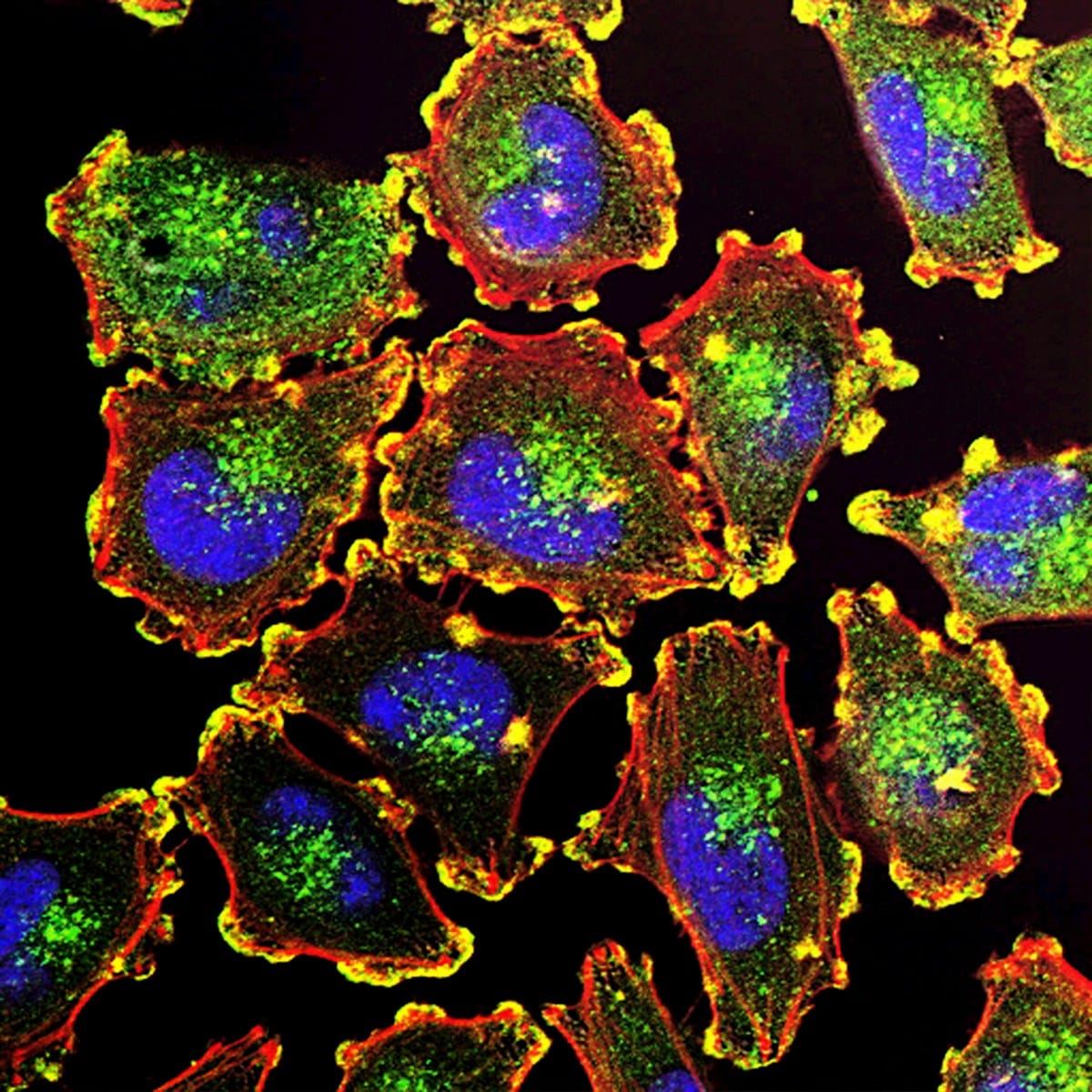
Tigilanol tiglate (EBC-46) is best known for its rapid acute effect on tumour vasculature, but the downstream cellular consequences include classical apoptotic signalling. Among the executioner enzymes involved in this programmed cell death are the caspase family — particularly caspase-3, caspase-9, and to a lesser extent caspase-8. Understanding their role helps clarify how tumour cells progress from initial membrane stress to full apoptotic dismantling.
What Caspases Do
Caspases are cysteine-aspartic proteases that exist in cells as inactive zymogens (procaspases). Once cleaved into their active forms, they execute the proteolytic events that define apoptosis: chromatin condensation, DNA fragmentation, plasma membrane blebbing, and ultimately the formation of apoptotic bodies for clearance by phagocytes. The pathway is broadly divided into initiator caspases (8, 9, 10) that transmit upstream signals, and effector or executioner caspases (3, 6, 7) that perform the actual disassembly.
In the intrinsic apoptotic pathway, mitochondrial outer membrane permeabilisation releases cytochrome c into the cytoplasm. Cytochrome c then assembles with Apaf-1 and procaspase-9 into the apoptosome complex, which activates caspase-9. Active caspase-9 cleaves and activates caspase-3, the principal executioner.
How EBC-46 Triggers the Cascade
Preclinical work on tigilanol tiglate has shown that, alongside its acute vascular effect, treated tumour cells display markers consistent with caspase-3 activation. This appears to follow upstream stress signals including reactive oxygen species accumulation, calcium-mediated ER stress, and mitochondrial membrane disruption. Together these inputs prime the intrinsic apoptotic pathway, recruiting caspase-9 and progressing to executioner caspase activation.
A Boyle et al. 2014 paper published in Scientific Reports described the broader cellular response in tumour models exposed to tigilanol tiglate, noting both the rapid haemorrhagic-necrotic response in vivo and slower apoptotic features in cell culture systems where vascular effects are not at play. This dual character — fast necrotic in vivo, slower apoptotic in vitro — is consistent with how caspase activation typically unfolds over hours rather than minutes.
Why the Distinction Between Necrosis and Apoptosis Matters
In whole tumours, the dominant in vivo observation after intratumoral injection is rapid haemorrhagic necrosis driven by acute vascular collapse. But in surrounding tissue and surviving tumour cells exposed to lower drug concentrations at the periphery, the slower caspase-driven apoptotic programme appears to play a meaningful role. This combination — cytotoxic necrosis at the core, controlled apoptosis at the margins — may help explain the relatively clean wound resolution observed in published clinical and veterinary outcomes.
It is worth noting that autophagy has also been proposed as a parallel cellular response, and these pathways are not mutually exclusive. The same cell can engage caspase-mediated apoptosis while neighbouring cells, or the same cell at a different stage, engage autophagic recycling.
What Cell-Line Studies Have Observed
Markers commonly used to track caspase activation include cleaved PARP-1 (a downstream substrate of caspase-3), the cleaved-to-pro-caspase-3 ratio measured by Western blot, and Annexin V/propidium iodide flow cytometry to distinguish apoptotic from necrotic cells. Studies on tigilanol tiglate-treated cell lines have reported increases in these markers in a dose-dependent fashion, with effects becoming visible within several hours and progressing over 24 to 48 hours.
Importantly, these are preclinical observations from cell-line and animal studies. They do not translate directly into human clinical predictions and have not been used to support consumer health claims for any blushwood berry extract supplement.
Reading This in Context
Caspase-mediated apoptosis is a mechanistic pathway, not a clinical effect. It tells us how tigilanol tiglate appears to engage tumour cell death machinery in the laboratory, which informs how researchers think about drug development. For the consumer dietary supplement category, blushwood berry extract products such as those offered by Blushwood Health are food supplements regulated under DSHEA in the United States and equivalent botanical supplement frameworks elsewhere, and they make no therapeutic claims based on these mechanistic findings.
This article is for informational purposes only. Statements about dietary supplements have not been evaluated by the Food and Drug Administration. Blushwood berry extract supplements are not intended to diagnose, treat, cure or prevent any disease. Consult a qualified healthcare professional before beginning any supplementation programme.
Citations
2. Galluzzi L et al. Molecular mechanisms of cell death: Recommendations of the Nomenclature Committee on Cell Death 2018, Cell Death & Differentiation, 2018.
3. QBiotics — Tigilanol Tiglate Programme Overview, accessed 2026.
Related Articles
Autophagy in EBC-46 Tumour Cell Death: Cellular Recycling Mechanism